

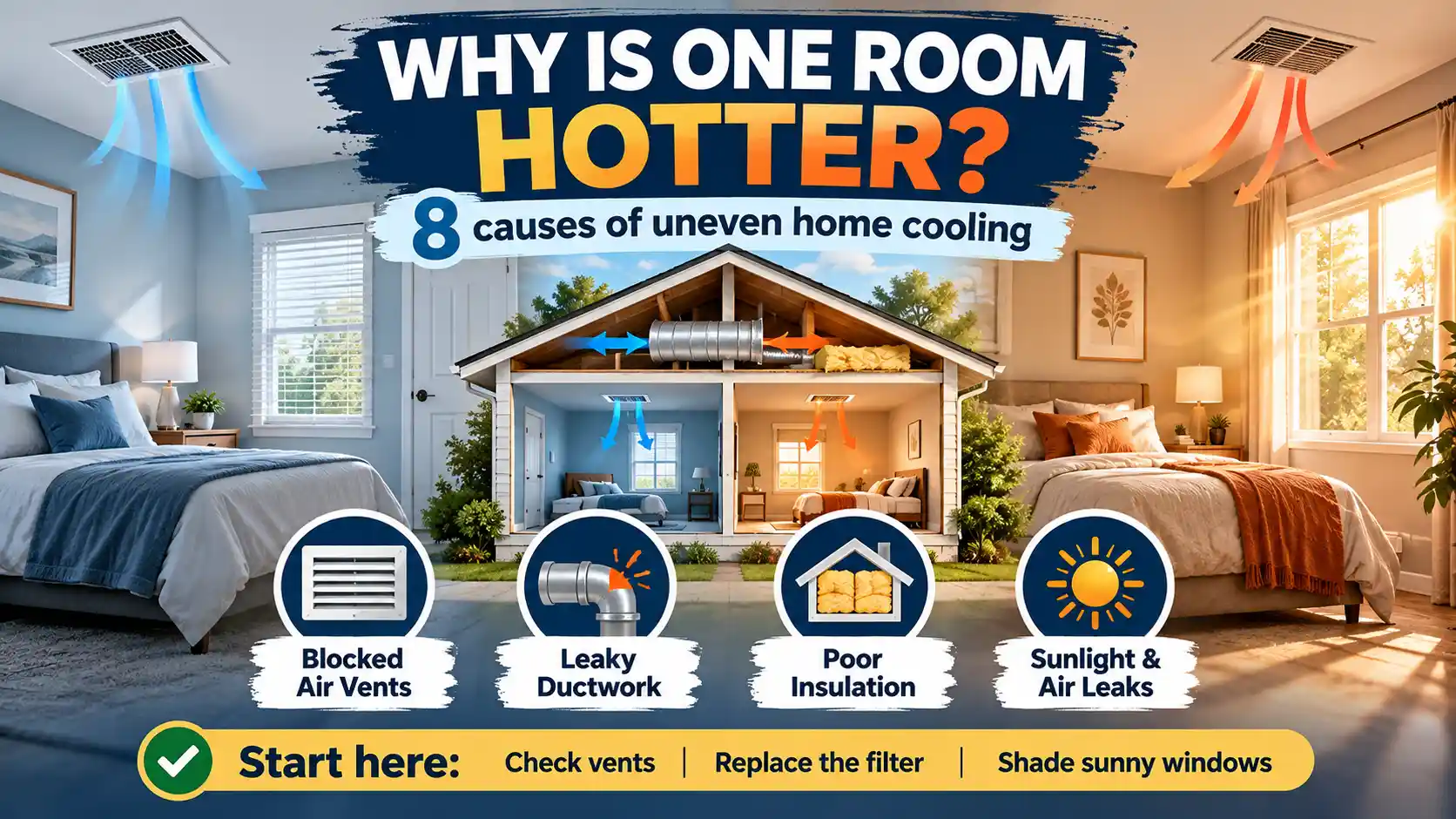
Why Is One Room in Your House Hotter Than the Others? 8 Causes Worth Checking
You set the thermostat to a comfortable temperature, the air conditioner starts running, and the living room begins to cool. But when you walk into the bedroom at the end of the hallway, it feels like the AC never reached it. The room is stuffy, the air feels heavy, and turning the thermostat down does not seem to solve the problem.
This kind of temperature difference can make everyday life uncomfortable. It may also leave homeowners wondering whether their air conditioner is too small, their ductwork is damaged, or something in the house needs attention.
The answer is not always a faulty AC unit. A room can stay warmer because it gains heat faster than other spaces, receives less conditioned air, or does not release heat as effectively. Window exposure, insulation, airflow, and the home’s layout can all play a part.
Below, we explain eight possible causes, simple observations you can make at home, and when it makes sense to contact an HVAC professional or home inspector.
First, Notice When the Room Gets Hot
Before trying to fix anything, look for a pattern. The timing of the temperature difference can offer useful clues.
- Hot mainly in the afternoon: Sunlight through windows or heat entering through the roof and exterior walls may be contributing.
- Hot throughout the day: Restricted airflow, ductwork concerns, or differences in the room’s cooling needs may be involved.
- Hot mostly when the bedroom door is closed: Air circulation or the room’s return-air pathway may deserve attention.
- Hotter upstairs than downstairs: Roof exposure, attic insulation, and the distribution of conditioned air may be factors.
- Hot despite apparently normal airflow: Windows, insulation, air leakage, or the room’s overall heat gain may need closer evaluation.
These patterns do not confirm a diagnosis. They help you decide what to check first and explain the issue more clearly to a professional.
1. The Room Is Not Receiving Enough Conditioned Air
Your air conditioner can be working while one room receives less cooled air than it needs. This may happen when an air vent is blocked, a damper is incorrectly positioned, or the duct system does not distribute air evenly.
Consider a bedroom where a dresser sits directly in front of the supply register. The AC may be producing cool air, but the furniture interferes with how that air enters the room. The bedroom can remain warm while the hallway feels comfortable.
Check these areas first:
- Is the supply register fully open?
- Are furniture, rugs, or curtains blocking an air outlet?
- Does the airflow seem weaker than it does in nearby rooms?
- Are several rooms experiencing the same problem?
Move obstructions away from vents and clean accessible vent covers. Maintain the HVAC filter according to the equipment manufacturer’s instructions.
If airflow still seems weak, an HVAC technician can measure it and investigate possible restrictions. Avoid closing vents throughout the rest of the house as a quick fix, because doing so may interfere with the system’s designed airflow.
2. The Ducts May Be Losing Cool Air Before It Reaches the Room
Ductwork is the delivery route for conditioned air. Loose connections, damaged sections, restrictions, or deteriorated insulation can affect how effectively that air reaches individual rooms.
The problem may be harder to notice when ducts run through a hot attic or another unconditioned space. In those locations, duct condition and insulation can influence cooling performance.
Possible clues include:
- One room has noticeably weaker airflow.
- The problem persists even after the vent is cleared.
- Multiple rooms connected to the same duct branch feel uncomfortable.
- Cooling performance appears to worsen during very hot weather.
A visible vent does not reveal the condition of the entire duct system. If you suspect a duct problem, arrange for a qualified HVAC professional to inspect accessible ductwork, connections, insulation, and system airflow.
Do not crawl into an unsafe attic or attempt to repair hidden ducts without appropriate training and equipment.
3. Heat Is Entering Through the Attic or Exterior Walls
A room can receive enough cooled air and still struggle to stay comfortable if heat continuously enters through the building envelope.
Insulation slows heat transfer through ceilings, walls, and other parts of the home. If insulation is missing, damaged, compressed, or insufficient for the space, the room may gain heat more quickly than expected.
This can be especially noticeable in a bedroom beneath the roof, a room above a garage, or an upper floor exposed to strong afternoon sun.
What to look for:
- The ceiling or upper part of the room feels warmer during sunny weather.
- The upstairs remains uncomfortable after the downstairs cools.
- The room heats up quickly when outdoor temperatures rise.
- The same room is repeatedly warmer despite normal-looking airflow.
These observations may point toward an insulation or heat-transfer concern, but they are not proof that insulation is the only problem.
A home inspector may identify visible insulation deficiencies where accessible. An insulation specialist or energy-efficiency professional can assess the situation in more detail and recommend suitable improvements.
4. The Windows May Be Bringing in Too Much Solar Heat
Two bedrooms in the same house can experience very different conditions simply because their windows face different directions.
A room with large west-facing windows may receive strong afternoon sunlight. Another room on the shaded side of the house may remain cooler at the same thermostat setting.
The glass, frame, window coverings, exterior shade, and window’s energy performance all influence how sunlight affects indoor comfort.
Try observing the room at different times:
- Is it comfortable in the morning but much warmer later?
- Does the area beside the window feel noticeably hotter?
- Does closing the blinds reduce the discomfort?
- Does the room receive more direct sunlight than nearby rooms?
If sunlight appears to be a major contributor, close suitable blinds or curtains before the hottest part of the day. Exterior shading may also help where practical.
For a longer-term improvement, discuss window energy performance and solar heat gain with a qualified window professional. Replacing windows is not necessarily the first step; the best option depends on the existing windows and the room’s overall conditions.
5. Small Gaps May Be Allowing Outdoor Air Inside
A window can look closed and still have worn weatherstripping or gaps around its frame. Similar issues can occur around exterior doors and other openings.
When hot outdoor air enters a room, the cooling system must remove the additional heat. In humid climates, incoming outdoor air can also add moisture, making the room feel uncomfortable.
Inspect accessible areas for:
- Cracked or loose weatherstripping.
- Visible gaps around window or door frames.
- Damaged seals.
- Drafts near closed exterior doors or windows.
You can repair minor, accessible sealing problems with suitable products when appropriate for the material and location. For persistent drafts or suspected hidden leakage, consider a professional air-leakage assessment.
Keep in mind that a room that feels hot does not automatically have an air leak. The source may instead be solar heat, restricted airflow, insulation, or a combination of conditions.
6. The Room May Not Have an Effective Air-Return Path
Cool air needs to enter a room, but the air must also be able to circulate back through the home’s HVAC system. The return-air arrangement varies from house to house.
In some homes, closing a bedroom door can change pressure and airflow if there is no suitable return-air pathway. The result may be a room that feels more stuffy when the door remains shut.
For example, if a bedroom is comfortable with the door open but noticeably warmer overnight with the door closed, make a note of that difference. It is a useful observation for a technician, though it does not by itself establish the cause.
What you can do:
- Keep supply vents and return grilles unobstructed.
- Check whether a large piece of furniture covers an air grille.
- Compare comfort with the door open and closed.
- Note whether the problem occurs only when the room is occupied for several hours.
Ask an HVAC professional to assess the room’s return-air arrangement if the pattern continues. Do not cut a door or wall to create an opening without professional guidance.
7. The HVAC System May Not Be Distributing Air Evenly
A home’s cooling needs are not necessarily the same in every room. A shaded room with few windows may need less cooling than a large, sunny bedroom.
Duct layout, the length of individual duct runs, damper settings, obstructions, and room-by-room heat gain can all influence how evenly the system performs.
This is why adjusting the thermostat may not solve the problem. The thermostat measures conditions at its own location; it cannot guarantee that every bedroom has reached the same temperature.
Signs that airflow balancing may need attention include:
- One or two rooms remain warm while the rest of the house feels comfortable.
- The issue continues after obvious obstructions are removed.
- Airflow differs significantly between rooms.
- Lowering the thermostat makes other areas too cold before the affected room becomes comfortable.
A qualified HVAC technician can evaluate airflow and duct design, check accessible dampers, and determine whether adjustments are appropriate. The correct solution depends on the system and the room’s cooling requirements.
8. The Air Conditioner May Need Maintenance or Further Testing
Sometimes the problem involves the HVAC equipment rather than one particular room. A maintenance issue or malfunctioning component can reduce the system’s ability to cool the house effectively.
Potential concerns include a neglected filter, restricted airflow through the equipment, a refrigerant issue, or a component that is not operating as intended. Equipment sizing and the home’s current cooling demands may also deserve evaluation.
However, one warm room alone does not prove that the air conditioner is failing or incorrectly sized.
Arrange professional HVAC service if you notice any of the following:
- The system runs for long periods without maintaining comfort.
- Airflow is weak across several rooms.
- Cooling performance has changed noticeably.
- Ice appears on equipment or refrigerant lines.
- You notice water around the system or unusual operating noises.
- Energy bills rise unexpectedly without an obvious explanation.
Do not open sealed equipment or attempt refrigerant repairs yourself. A qualified technician can test system operation and identify what, if anything, requires repair.
A Simple Homeowner Check Before Booking a Service Visit
You do not need special equipment to begin gathering useful information. A few careful observations can help narrow down the possibilities.
Use this checklist
- Check that supply vents are open and unobstructed.
- Inspect and maintain the HVAC filter according to its instructions.
- Move furniture away from air outlets and return grilles.
- Observe whether direct sunlight makes the room warmer.
- Check visible window and door seals for damage.
- Compare the room’s comfort in the morning and afternoon.
- Note whether closing the bedroom door changes the problem.
- Record whether other rooms are affected at the same time.
If you use a thermometer, compare rooms at similar heights and avoid placing it directly in sunlight or beside a vent. Repeated readings taken under similar conditions are more useful than a single measurement.
Keep a short note of what you observe. For example: “The west-facing bedroom becomes uncomfortable after 3 p.m., but the hallway remains cool.” That description is more useful to a technician than simply saying the room is always hot.
Avoid repeatedly lowering the thermostat to compensate for one room. It may cause other rooms to become too cold without addressing the underlying issue.
HVAC Technician or Home Inspector: Who Should You Contact?
The right professional depends on what you need to find out.
Contact an HVAC technician when you need to:
- Diagnose weak or uneven airflow.
- Test cooling-system performance.
- Investigate suspected duct leakage.
- Evaluate system maintenance, operation, or balancing.
- Determine whether repairs or further HVAC testing are necessary.
A home inspection may be useful when you want to:
- Understand the visible condition of a property.
- Identify observable concerns with accessible vents, insulation, ductwork, or HVAC components.
- Document visible defects while buying or selling a home.
- Determine whether a visible condition warrants specialist evaluation.
A standard home inspection is not a substitute for detailed HVAC diagnostics. The inspector’s ability to assess a particular condition depends on the inspection scope, access, and conditions at the time.
For homeowners in Gainesville and nearby North Central Florida communities, a home inspection can help document visible property concerns. If the central question is why one room will not cool properly, a qualified HVAC technician is generally the appropriate specialist for diagnosing system performance.
Learn more about home inspection services in Gainesville, FL, and nearby communities by contacting Home Inspection Group LLC.
Recent Comments